
Views:342times
Huyi Community:Community Events
Release time:2026-02-21 15:21:15
Community Engagement:The objective of this workshop is to examine the benefits and practical implementation of research strategies that integrate the design and deployment of digital learning environments (DLEs) to investigate management models within specific local contexts. The proposed research design enables scholars to analyse the social and cognitive behaviours of participants engaged in simulated managerial practices. Such an approach supports the development of theoretically grounded assumptions and hypotheses by fostering a deeper understanding of management phenomena from a contingent and micro-level perspective. The workshop will further explain how the design and implementation of a virtual learning environment (VLE) can serve as a core component of the research architecture. Within this framework, participants immerse themselves in simulated work-life scenarios that replicate authentic managerial situations, creating a structured yet dynamic setting for observing, analysing, and theorising managerial action.
Contact: Please send email to: community@huyixiang.com.cn for more information
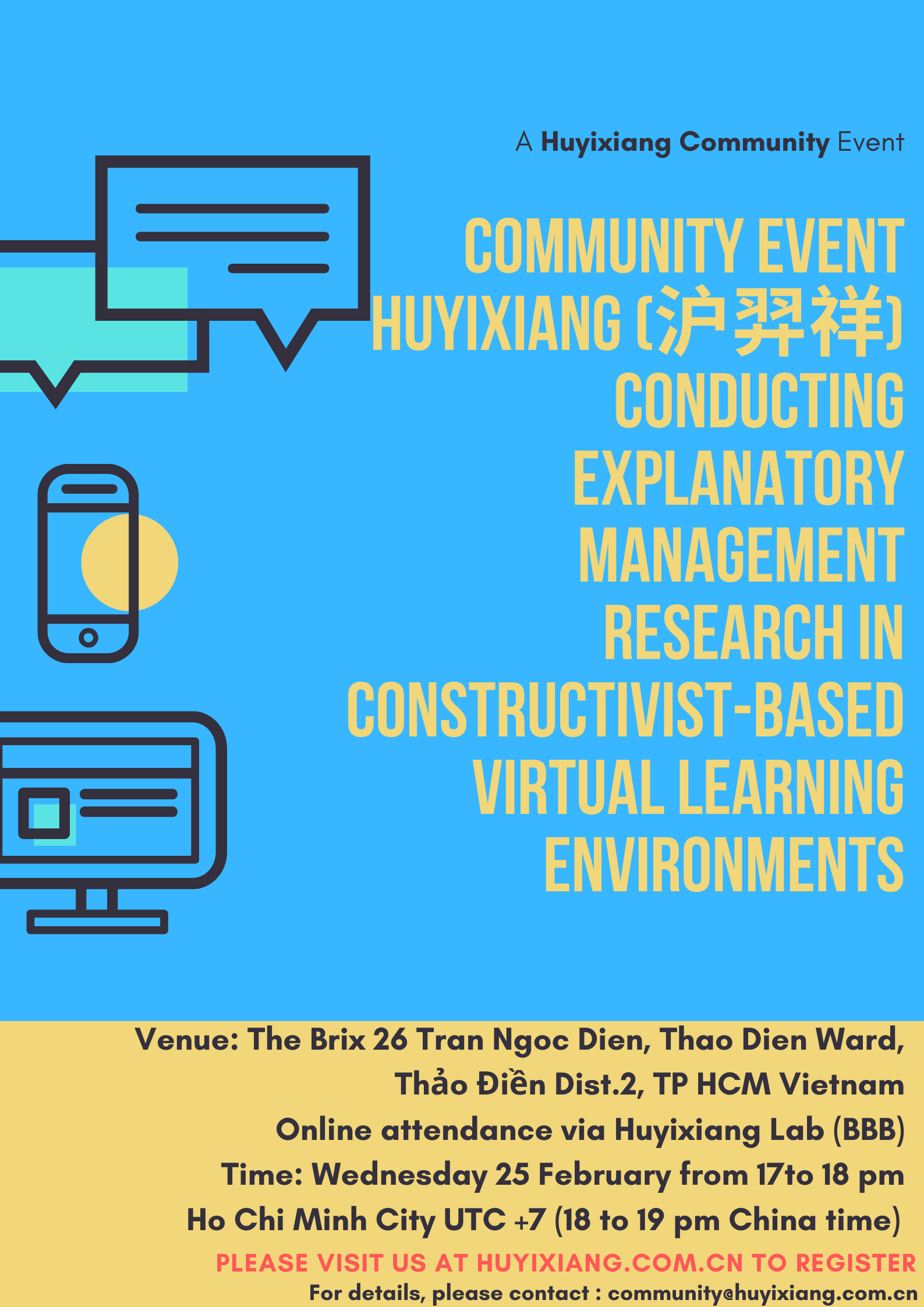
Conducting explanatory management research using constructivist-based digital learning environments: opportunities, guidelines, feedback from experience
Workshop Description
Duration: 1 hour
Venue: The Brix 26 Tran Ngoc Dien, Thao Dien Ward, Thảo Điền Dist.2, TP HCM Vietnam
Online attendance via Huyixiang Lab (BBB)
Time: Wednesday 25 February from 17to 18 pm
Ho Chi Minh City UTC +7 (18 to 19 pm China time)
This workshop introduces an innovative research strategy that integrates digital learning environments (DLEs) into management research design, combining practice-based inquiry, theory building, and technology-enabled data collection.
After attending this workshop, participants will be able to:
Critically assess the advantages and limitations of applying innovative, digitally embedded research designs within their own research areas and projects.
Design and develop appropriate research strategies, tools, and data collection instruments using constructivist-based digital learning environments.
Integrate methodological choices (qualitative, quantitative, or mixed-method approaches) into immersive research settings.
Critically review and refine their research plans through structured peer feedback and scholarly discussion.
Part 1: Innovative Research Methods for Management Research (20 mns’)
The first part examines emerging methodological approaches in management sciences. It discusses the role of practice-based research and management education as experimental spaces for theory development. Particular attention is given to:
Indigenous management research methods and context-sensitive theory building;
The contribution of abductive reasoning in developing and refining theoretical constructs;
The integration of digital technologies in inductive and explanatory research;
The use of digital learning ecosystems as research laboratories for studying social and cognitive behaviors in management contexts.
Participants will explore how digitally mediated environments can enhance micro-level analysis and support contingent, context-aware theorising.
Part 2: Case Application in Managerial Control Research – 20 mns
The second part presents a doctoral research case study conducted in China, illustrating the implementation of a Virtual Constructivism-Based Learning Environment (VCLE) within a Learning Management System (LMS).
The research design simulated a consultancy project in which participants collaboratively constructed a performance measurement dashboard for a fictitious organisation. The immersive environment recreated real-life managerial scenarios, enabling the observation and measurement of socio-cognitive behaviours during knowledge construction processes.
Using an exploratory sequential design, the study:
Developed preliminary assumptions grounded in managerial control theory and collaborative learning research;
Operationalised psychological and socio-cognitive constructs through composite variables;
Analysed behavioural patterns through mixed-method data collection (qualitative and quantitative);
Refined theoretical assumptions through iterative testing and triangulation.
The research investigated how the interplay between instrumental rationality and communicative rationality influences the construction of managerial control systems. Findings suggest that performance measurement systems emerge from the dynamic interaction between these two dimensions of social action.
Beyond its theoretical contribution, the study demonstrates how digitally simulated environments provide robust conditions for examining managerial behaviours, socio-cognitive conflicts, and causal relationships in contingency-based managerial control research.
Part 3: Practical Roadmap for Research Design (20 mns)
The final part provides a structured framework for designing research projects using constructivist-based digital learning environments. Participants are introduced to a three-step research roadmap that integrates:
Theory grounding and construct exploration;
Experimental design and data operationalisation;
Iterative theory testing and refinement through mixed-method analysis.
Practical guidelines, instruments, and methodological templates are presented to support participants in adapting the approach to their own research contexts.
Target Participants
This workshop is designed for:
Business and management scholars (accounting, strategy, organisational behaviour);
Social sciences researchers investigating localised management phenomena;
Psychologists interested in cultural and socio-cognitive processes;
Education and learning sciences researchers working with digital environments;
Methodologists and developers of digital research tools.
Workshop Facilitator: Dr Jean-Yves Le Corre
How to attend ?
If you are attending on site: don't hesitate to get in touch with the organiser directly +84906921781 or connect to Huyi Community Vietnam on Zalo: https://zalo.me/g/mazmbw931
How to attend the event remotely via Huyixiang(沪羿祥) EduLab?
If you are already registered as member of Huyi Community (China)
Please log in to Huyi Community Portal (China) using your account and copy the link below into your browser:
Weblink: https://elearning.chinait.com/eyfs/mod/bigbluebuttonbn/view.php?id=2826
If you are not yet registered as member of Huyi Community
Please write with us at community@huyixiang.com.cn to register at least two days before the event. After completing their registration to Huyi Community, we will be sending your account details to login into Huyixiang(沪羿祥) EduLab and the virtual room of the event.
Attendance is free of charge.
Useful References
Le Corre J-Y, Burger-Helmchen T. Managerial Control in an Online Constructivist Learning Environment: A Teacher’s Perspective. Knowledge. 2022; 2(4):572-586. https://doi.org/10.3390/knowledge2040034
https://scholar.xjtlu.edu.cn/en/publications/managerial-control-in-an-online-constructivist-learning-environme
Le Corre J., Tang, S., Zhu, Y.(2021) ‘Measuring Collaborative Behaviours in Virtual Constructivist Learning Environments: Process-level Approach & Methodology’, International Journal of Design, Analysis, and Tools for Integrated Circuits and Systems, Vol 10, n. 1, ISSN 2071-2987
https://scholar.xjtlu.edu.cn/en/publications/measuring-collaborative-behaviours-in-virtual-constructivist-lear
Le Corre JY., Xu, S. (2023) Immersive Learning in Management Accounting Education: A Prototype of Classroom-as-Organization Supported by Learning Management System and Virtual Reality In: Harnessing Technology for Knowledge Transfer in Accountancy, Auditing, and Finance, DOI: 10.4018/979-8-3693-1331-2
Le Corre J., ‘Instructional Design Model of Virtual Reality digital integration: an experimental case study in managerial control education’. Presentation (virtual) at the Asian Conference on Education (ACE2023), Tokyo, Japan, November 2023 (https://vimeo.com/885485635)